

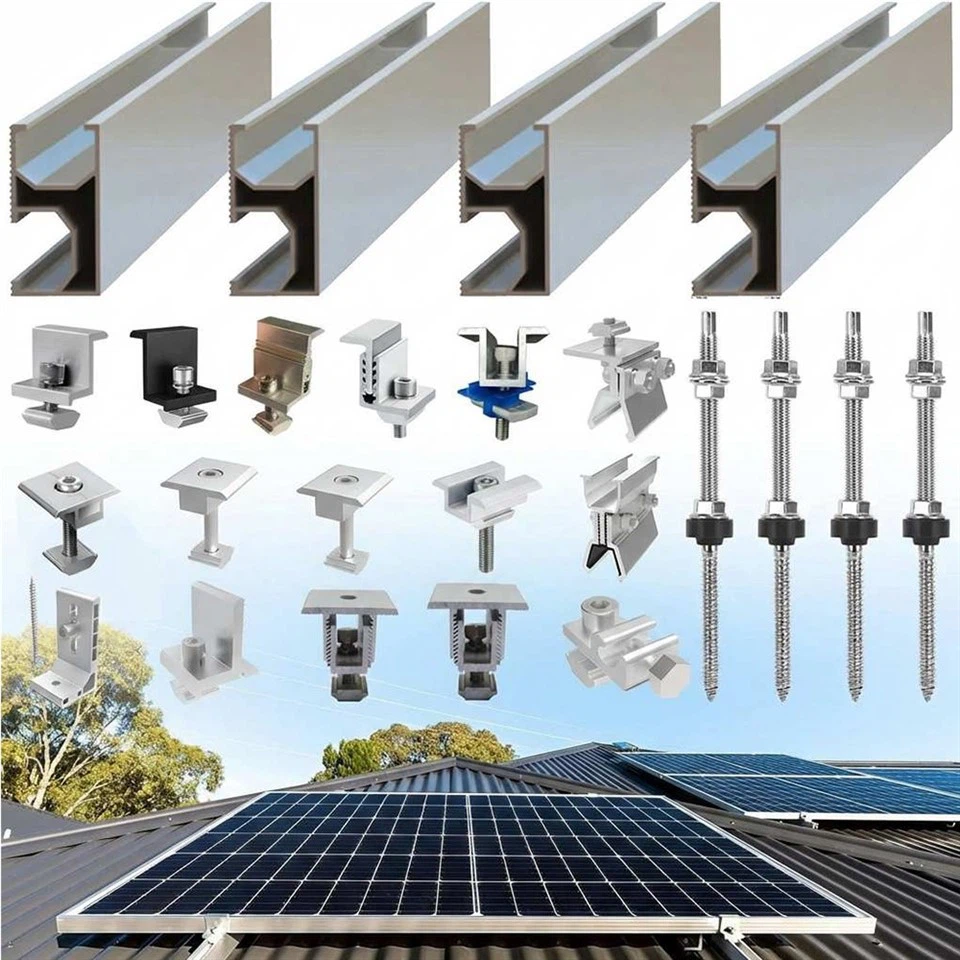


Selecting the optimal length for solar mounting rails on large-scale project sites requires balancing container logistics efficiency with on-site structural stability. Standardizing rail lengths to maximize the volume usage of a 40ft High Cube (HC) container prevents shipping displacement and reduces maritime freight costs per megawatt. This analysis establishes the mechanical and logistical framework for choosing customized solar rail lengths that maintain structural compliance under high wind loads while eliminating field cutting waste.
Container Logistics: Balancing Rail Length with 40ft HC Loading Efficiency
Logistical constraints dictate the initial parameters of solar racking engineering. Standard 40ft HC shipping containers feature an internal length of 12.032m. When specifying a customized solar rail length, engineering designs must accommodate these precise dimensions to prevent dead space or manual loading complications at the manufacturing facility.
Specifying a rail length of 5.80m or 4.20m allows for optimal utilization. Two packs of 5.80m rails fit longitudinally within a 40ft HC container, leaving a total clearance margin of 432mm for forklift operations, timber pallets, and end-protection packaging. Choosing arbitrary lengths such as 6.20m forces the logistics team to utilize break-bulk shipping or open-top containers, which escalates freight budgets.
The table below details the loading density and volumetric utilization rates for AL6005-T5 aluminum solar mounting rails across standard export configurations.


Structural Integrity: On-Site Rail Splicing vs. Continuous Rail Mechanical Performance
Structural engineers must calculate the trade-off between utilizing continuous, single-piece solar mounting rails and implementing shorter rail segments joined by external rail splices. A continuous rail distributes localized wind uplift loads across multiple roof hooks or ground mount legs. Conversely, a spliced system introduces distinct joints that alter the bending moment diagram of the structural assembly.
When subjected to dynamic wind pressures according to AS/NZS 1170.2 standards, the splice connection serves as a pivot point. The yield strength of AL6005-T5 alloy is $\ge 240\text{ MPa}$. When an external splice is secured with SUS304 bolts, the joint retains approximately 85% to 90% of the continuous rail's ultimate bending moment capacity. Therefore, engineering blueprints must position rail splices at points of minimum bending moment-typically at a distance of $0.2L$ from the support bracket, where $L$ represents the span distance.
Frequently Asked Questions
What is the maximum continuous rail length recommended before requiring a thermal expansion gap?
A thermal expansion gap is required every 12 to 15 meters of continuous aluminum rail run. Aluminum AL6005-T5 expands and contracts with temperature fluctuations; omitting expansion joints causes structural warping, fastener loosening, and localized stress on the solar module frames.
How does customized rail length impact the total project installation timeline?
Customized factory-cut rails reduce installation labor times by up to 35%. Eliminating on-site measuring, cutting, and re-anodizing allows installation crews to immediately fasten rails to roof hooks or ground mounts without mechanical processing delays.
What is the Minimum Order Quantity (MOQ) for customized solar rail lengths?
The standard manufacturing MOQ for custom extruded rail profiles cut to project-specific lengths is 5,000 linear meters. This volume matches the raw billet extrusion efficiency cycles of our factory equipment to keep per-meter costs equivalent to stock lengths.
Hot Tags: solar mounting rails for solar projects, China, suppliers, manufacturers, factory, wholesale, customized, sample, in stock