

Marine photovoltaic installations operate under extreme atmospheric stress, classified under ISO 9223 C5-M (Marine) corrosivity conditions. Standard terrestrial solar racking fails rapidly when exposed to continuous salt spray, high UV degradation, wave-induced dynamic loads, and wind speeds exceeding 60 m/s. Selecting marine solar panel mount systems manufactured with AL6005-T5 anodized aluminum (film thickness ≥15μm) and SUS316 stainless steel hardware prevents galvanic degradation, structural fatigue, and mechanical fastener loosening on boats and yachts.
Metallurgical Degradation & Material Selection in Marine Environments
Ocean environments introduce severe pitting corrosion and galvanic reactions when dissimilar metals interact in the presence of an electrolyte (sea water). Standard AL6063-T5 or SUS304 steel components, widely used in land-based solar farms, lack the required molybdenum content and anodic protection depth for saltwater immersion and spray zones.
To prevent micro-cracking, chloride pitting, and structural yield loss, mounting structures must meet specific metallurgical criteria:
- AL6005-T5 Aluminum Alloy: Delivers a minimum tensile strength of 260 MPa and yield strength of 240 MPa. An anodizing layer of 15μm to 25μm (Qualanod certified) provides an oxide barrier against chloride ion penetration.
- SUS316 (A4-70) Stainless Steel: Contains 2.0–3.0% Molybdenum, increasing resistance to localized pitting and crevice corrosion compared to SUS304 (A2-70).
- Galvanic Isolation: EPDM gaskets (durometer Shore A 70±5) and nylon isolation washers must separate aluminum frames from stainless steel fasteners to maintain an electrochemical potential difference below 0.15V.
Engineering Material Comparison for Marine Racking Systems
| Performance Parameter | Standard AL6063-T5 | Marine-Grade AL6005-T5 | Stainless Steel SUS304 | Stainless Steel SUS316 |
| Tensile Strength (MPa) | ≥ 185 | ≥ 260 | ≥ 520 | ≥ 600 |
| Yield Strength (MPa) | ≥ 145 | ≥ 240 | ≥ 205 | ≥ 240 |
| Anodized Film Thickness | 10μm | 15μm – 25μm | N/A | N/A |
| Pitting Resistance Equivalent (PREN) | N/A | N/A | 18.0 – 20.0 | 23.0 – 25.0 |
| ASTM B117 Salt Spray Endurance | 500 Hours | > 3,000 Hours | 1,000 Hours | > 3,000 Hours |
| KingGalvanic Compatibility with Carbon | Moderate Risk | Low (With Isolation) | High Risk | Low (With Isolation) |


Need certified technical drawings or custom aluminum profile extrusions for your marine solar projects?
Contact our engineering team to review our ABS Solar Mount and Z Brackets technical datasheets.
Mounting Configurations for Yachts, Catamarans, and Commercial Vessels
Marine solar racking must integrate into varying vessel geometries without compromising hull aerodynamics or deck safety. System design varies based on the target mounting surface.
1.Curved Deck & Flat Roof Mounting
Rigid solar panels on flat biminis, cabin tops, or RV/marine roofs require non-penetrative or sealed perimeter mounts. Aerodynamic molded ABS brackets distribute wind uplift loads across a wide surface area while maintaining an air gap of 30mm–50mm beneath the module to prevent thermal efficiency losses.
2.Rail & Arch Structure Mounting
Yacht stern arches and 25mm–32mm bimini tube frames require heavy-duty 316 stainless steel rail clamps. Dual-axis adjustable mounts allow installers to adjust panel inclination from 0° to 45° to maximize solar irradiance capture based on latitude.


3. Flush-Mounted Deck Profiles
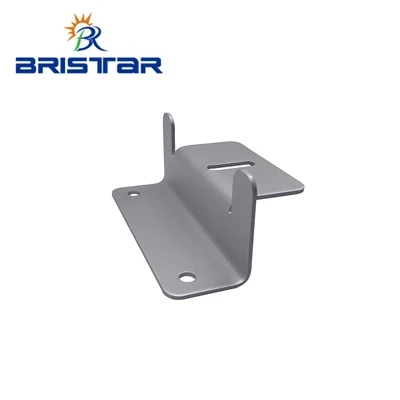
For walk-on deck areas, ultra-low-profile anodized aluminum Z-brackets or recessed mounting tracks secured with marine-grade polyurethane sealant (Sika Flex 291i) and A4-70 countersunk fasteners provide low profile wind-shear resistance.
Quality Control & Compliance Testing Standards
Xiamen Bristar Technology Co.,Ltd subjects all marine racking lines to rigorous laboratory verification before bulk shipment. Structural calculations undergo finite element analysis (FEA) to verify stress distribution under extreme conditions:
- Wind Resistance Testing: Structural verification under simulated wind speeds up to 60 m/s (134 mph).
- Salt Spray Corrosion Resistance: Compliance with ASTM B117 testing exceeding 3,000 hours without red rust formation on steel components or white pitting on aluminum surfaces.
- Mechanical Load Capability: Frontal pressure load testing up to 5,400 Pa (snow/wave impact) and rearward suction load testing up to 2,400 Pa (wind uplift) per IEC 61215 standards.
Frequently Asked Questions (FAQ)
What material is best for solar panel mounting brackets on boats?
Anodized AL6005-T5 aluminum alloy (film thickness ≥15μm) combined with SUS316 (A4-70) stainless steel fasteners provides the optimal strength-to-weight ratio and corrosion resistance for marine environments, easily withstanding ISO 9223 C5-M atmospheric conditions.
How do marine solar mounts prevent galvanic corrosion between aluminum and stainless steel?
Galvanic corrosion is prevented by installing non-conductive EPDM rubber gaskets, nylon washers, or polymer isolation sleeves between the aluminum frame and stainless steel bolts. This breaks the electrical contact and maintains a potential difference below 0.15V.
What is the minimum MOQ and OEM lead time for custom marine solar brackets?
Our standard factory MOQ for custom or wholesale marine solar mounting brackets is 500 sets. OEM design verification and sample production require 7–10 working days, with mass production completed within 15–20 days under ISO 9001 certified manufacturing processes.