

Maximizing volumetric container efficiency (CBM) during bulk solar racking exports requires precision nesting geometries and high-density palletization to prevent freight damage under maritime transport conditions. By engineering interlocking AL6005-T5 extrusion profiles and utilizing moisture-resistant packaging protocols, logistics managers reduce empty space ratios to below 8% while safeguarding components against dynamic load shifts.
1. Maximizing CBM Utilization and Volumetric Efficiency in 40HQ Containers
Shipping bulk photovoltaic mounting systems demands precise volumetric calculations to minimize freight overheads per megawatt. Standard 40-foot High Cube (40HQ) containers possess an internal volume of approximately 68 CBM, yet inefficient manual stacking often results in effective utilization rates falling below 70%.
- Nesting Optimization: Interlocking AL6005-T5 solar rails are nested profile-in-profile to eliminate dead air space, achieving a volumetric packing density of ≥ 85%.
- Weight Distribution Limits: Total payload per container is strictly capped at 26,000 kg to comply with international axle-load regulations and maritime safety standards (ISO 668).
- Dimensional Coordination: Rail lengths are precision-cut to 5.8 meters or 5.9 meters to fit directly within standard container dimensions without requiring hazardous diagonal loading.
| Container Type | Internal Volume (CBM) | Max Payload Limit | Target CBM Utilization |
| 20-Foot Standard (20GP) | 33 CBM | 21,800 kg | ≥ 80% |
| 40-Foot Standard (40GP) | 60 CBM | 26,600 kg | ≥ 82% |
| 40-Foot High Cube (40HQ) | 68 CBM | 26,500 kg | ≥ 85% |

2. Rail Nesting Geometry and Accessory Palletization Protocols
Unorganized small parts-such as SUS304 bolts, mid clamps, end clamps, and EPDM gaskets-account for the highest risk of loss and handling delays during site deployment. Standardized palletization resolves this vulnerability.
- Dedicated Hardware Pallets: Small components are sorted into heavy-duty corrugated cartons, stacked on ISPM 15 heat-treated wooden pallets, and shrink-wrapped with stretch film (thickness ≥ 0.05mm).
- Interlocking Profile Bundles: Long structural members (rails and ground-mount C-channels) are bound using high-tensile steel strapping combined with rubber edge protectors to prevent localized scratching of the anodic film (≥ 10um).
- Weight-Balanced Unitization: Pallets are engineered with a maximum footprint height of 1.1 meters to allow double-stacking inside containers without compromising structural integrity under rough transit vibrations.
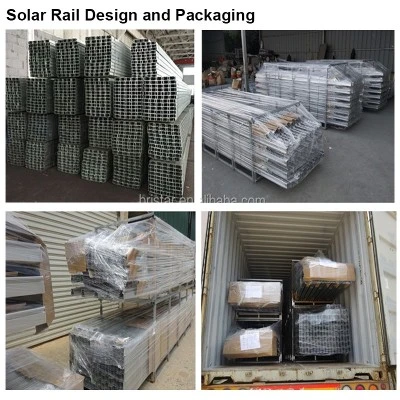
3. Marine Transport Protection: Mitigating Moisture and Dynamic Shock
Maritime transit exposes aluminum extrusions and steel fasteners to salt fog, condensation (container rain), and severe shock loads. Without active mitigation, galvanic corrosion can ruin component surfaces before installation.
- Desiccant Deployment: Each sealed 40HQ container incorporates a minimum of 12 units of high-absorption calcium chloride desiccant bags to maintain relative humidity below 50% during ocean transit.
- Corrosion Barrier Films: Coastal shipments utilize VCI (Volatile Corrosion Inhibitor) plastic interleaving films to protect mill-finish and anodized surfaces from saline atmospheric degradation.
- Shock and Vibration Dampening: High-density polyethylene (HDPE) foam spacers are inserted between stacked layers of solar profiles to absorb high-frequency harmonic vibrations encountered during transoceanic shipping.

4. Conclusion and Export Compliance Sign-Off
Stringent container loading protocols transform bulk solar shipping from a logistical variable into a predictable engineering science. By enforcing precise CBM utilization targets, automated rail nesting, and rigorous moisture protection, manufacturers ensure that structural components arrive at destination ports ready for immediate installation.
Frequently Asked Questions (FAQ)
What is the maximum weight capacity for a standard 40HQ container when shipping bulk solar brackets?
Total payload is strictly managed to a maximum limit of 26,500 kg to comply with international highway and maritime safety regulations under ISO 668.
How are smaller components like SUS304 bolts and clamps protected during long-distance ocean freight?
Small accessories are packed in reinforced corrugated cartons, secured on ISPM 15 compliant heat-treated wooden pallets, and wrapped in industrial stretch film.
What is the standard Minimum Order Quantity (MOQ) for customized container packaging and OEM pallet configurations?
Customized packaging designs and dedicated OEM container layouts typically require a minimum order quantity starting at 100kW of solar racking material.