

Waterproof commercial solar carports integrate primary structural framing with continuous aluminum gutter channels and EPDM rubber seals to achieve 100% surface water interception while maintaining structural stability under wind pressures up to 60 m/s and snow loads of 1.4 kN/m². Utilizing AL6005-T5 structural extruded profiles with anodized film thickness $\ge 10\mu\text{m}$ and SUS304 mechanical fasteners prevents galvanic corrosion and eliminates under-canopy water dripping over 25-year design lifespans. Proper gutter sizing, tilt angle optimization (5° to 15°), and hydraulic runoff capacity calculations per DIN 1986-100 standards protect commercial vehicle parking structures against heavy precipitation events.
Structural Water Interception & Drainage Architecture
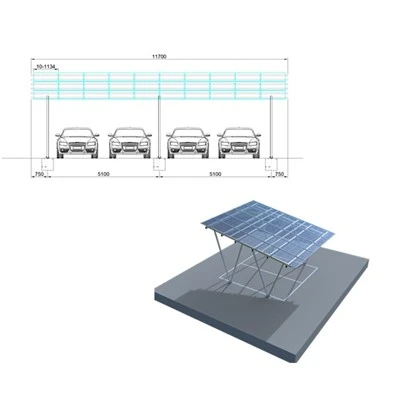
Commercial PV parking canopies require integrated fluid management systems to replace traditional corrugated roof sheeting with utility-grade solar modules. Mechanical waterproofing relies on a dual-tier drainage system comprising transverse primary gutters mounted between module rows and longitudinal main collection channels fixed along structural support beams.
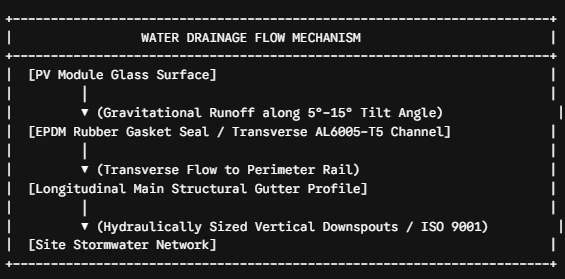
Extruded AL6005-T5 aluminum channels function both as structural mounting rails and water conveyance troughs. EPDM rubber gaskets (Shore A hardness $65 \pm 5$) inserted into module clearance gaps maintain elastic memory across thermal cycles ranging from -40°C to +120°C. Structural clamps apply calibrated torque (18–20 Nm) to secure PV module frames without compressing EPDM seals beyond their maximum 30% deformation threshold, ensuring long-term watertight sealing under dynamic wind lift forces per AS/NZS 1170.2 specifications.

| System Specification | Light-Duty Sheet-Gasket System | Integrated Extruded Gutter System | Heavy-Duty Double-Lock Aluminum System |
| Material Grade | Thin-gauge Steel / Synthetic EPDM | Extruded AL6005-T5 Aluminum | Anodized AL6005-T5 + SUS304 Hardware |
| King-Single | ≥180MPa | ≥240MPa | ≥260MPa |
| Water Clearance Rate | 85% - 90% | 98% | 100% |
| Max Wind Resistance | 38m/s | 50m/s | 60m/s |
| Service Life Expectancy | 10-12Years | 20Years | 25+Years |
| Salt Spray Resistance | 240 Hours (ASTM B117) | 500 Hours (ASTM B117) | >1000 Hours (ASTM B117) |
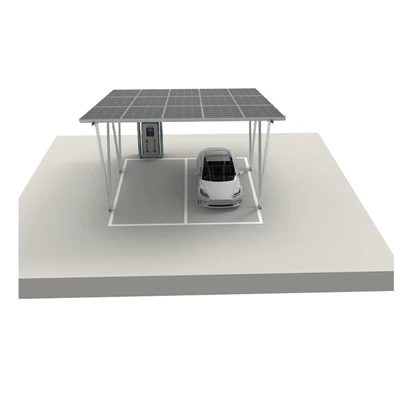
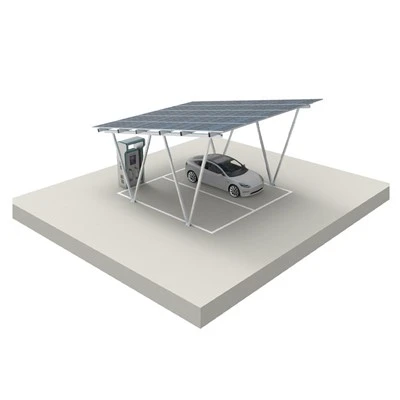

Request Solar Carport CAD Layouts
Hydraulic Calculations & Long-Span Runoff Design
Sizing commercial carport gutters requires calculating peak rainfall intensity using regional Hydrological Intensity-Duration-Frequency (IDF) curves. For a commercial array spanning 100 meters with a 10° tilt angle, the total projected catchment area Aeff dictates the required cross-sectional gutter area Ag and downspout discharge capacity Qd.
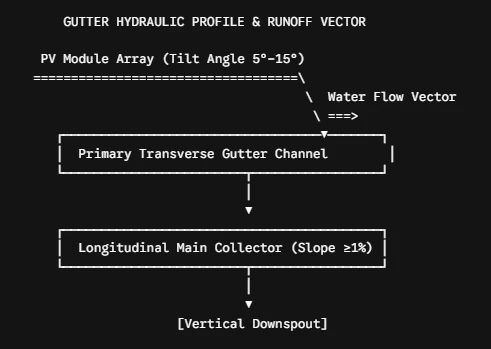
Hydraulic Discharge Capacity Formulation
Peak discharge flow rate (Q) is derived using the Rational Method:
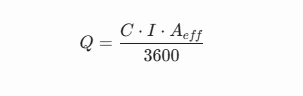
Where:

Frequently Asked Questions
How do integrated drainage systems prevent water leakage between PV modules?
Integrated systems utilize continuous EPDM rubber gaskets pressed securely between module edges via specialized AL6005-T5 aluminum mid-clamps. Water passing over module gaps flows into embedded transverse gutters, directing $100\%$ of runoff into main perimeter channels without relying solely on chemical sealants.
What slope gradient is required for effective solar carport water discharge?
A minimum structural tilt angle of 5° is required for gravity-driven water flow along module surfaces. Main longitudinal collection gutters require a minimum slope gradient of 1% (10mm per meter) toward vertical downspouts to prevent stagnant water pooling and sediment accumulation.
How do solar carport gutters perform under heavy snow loading?
Aluminum gutter channels are engineered to withstand snow loads up to 1.4 kN/m² per EN 1991-1-3 standards. Extruded AL6005-T5 profiles feature internal reinforcing ribs that prevent cross-sectional crushing or mechanical deformation during winter freeze-thaw cycles.