

Non-penetrating standing seam solar clamps utilize mechanical friction locking mechanism to secure PV modules to sheet metal roofs without puncturing the weather barrier. Engineered from high-tensile AL6005-T5 aluminum alloy and Grade 304 stainless steel hardware, these clamps achieve ultimate pull-out loads up to 3.8 kN while maintaining zero thermal expansion stress on the standing seams. This design preserves the original manufacturer warranty of the metal roof while providing structural resistance against wind speeds up to 60 m/s and snow loads of 1.4 kN/m².
Mechanical Engineering & Structural Integrity of Non-Penetrating Clamps
Traditional solar mounting methods requiring self-tapping screws compromise roof water-tightness and induce localized galvanic corrosion. Non-penetrating clamps eliminate leak risks through targeted clamping torque applied directly to the folded seam profile.
The clamping force relies on set screws-typically M8x25 stainless steel Grade A2-70-torqued to 15–18 Nm. This specific torque range deforms the clamp material slightly around the seam geometry without crimping or compromising the structural integrity of the roof sheet itself.
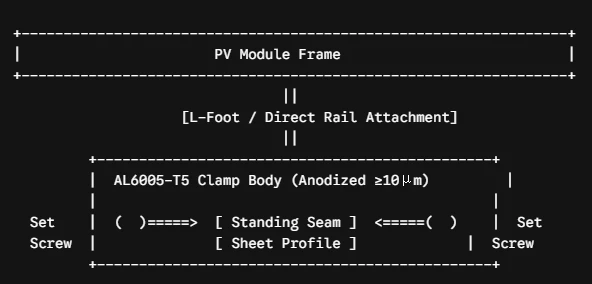
The primary alloy used, AL6005-T5 aluminum, undergoes artificial aging to achieve a minimum yield strength of 240 MPa and an ultimate tensile strength of 260 MPa. Surface protection is provided via anodization with a minimum film thickness of 10 μm (Class 10 as per ISO 7599), offering salt spray resistance compliant with ASTM B117 for 1,000 hours.

Technical Specifications: Material Comparison & Load Capacity
Selecting the appropriate mounting hardware requires evaluating yield strengths, corrosion resistance metrics, and pull-out capacities across various environmental exposures.
| Engineering Parameter | AL6005-T5 Aluminum Clamp | Hot-Dip Galvanized Steel Clamp | SUS304 Stainless Steel Hardware |
| Yield Strength (R_p0.2) | ≥240MPa | ≥235MPa | ≥205MPa |
| Tensile Strength (Rm) | ≥260MPa | 360-510MPa | ≥510MPa |
| Corrosion Protection | Anodized Film ≥ 10μm | Galvanized Layer ≥ 55μm | Passivated Material State |
| Weight per Unit | 0.18--0.35kg | 0.45--0.85kg | N/A |
| Standard Compliance | AS/NZS 1170.2, Eurocode 9 | ISO 1461, ASTM A123 | ISO 3506-1 |
| Ultimate Tensile Load | 3.2-4.5kN | 4.0--5.2kN | 6.5--8.0kN |
Different seam profiles-such as L-Profile, Double Lock Standing Seam, Snap-Lock, and Trapezoidal Seams-demand distinct clamp geometry to optimize load distribution.
Seam Profile Compatibility
1.Double Lock Standing Seam (38mm / 50mm): Requires two-piece round-head clamps to envelop the full fold without localized stress points.
2.Snap-Lock Profiles: Requires single-side pressure block designs to prevent unseaming under uplift loads.
3.Trapezoidal Standing Profiles: Utilizes side-mounted friction clamps with custom profile rubber inserts to compensate for manufacturing tolerances in sheet metal.
Request Custom Technical Drawings & OEM Quotes
Tensile Uplift Testing & Wind Load Resistance
Solar arrays installed on metal roofs experience severe uplift forces caused by dynamic wind pressure gradients. Structural compliance requires empirical verification under AS/NZS 1170.2 and EN 1991-1-4 standards.
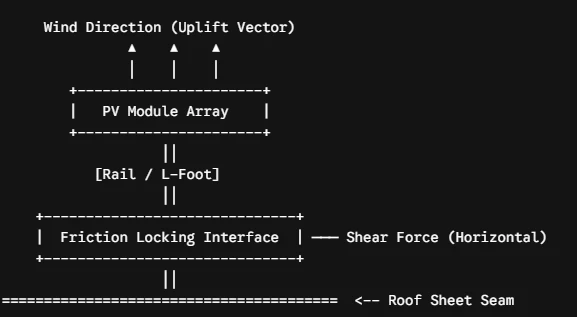
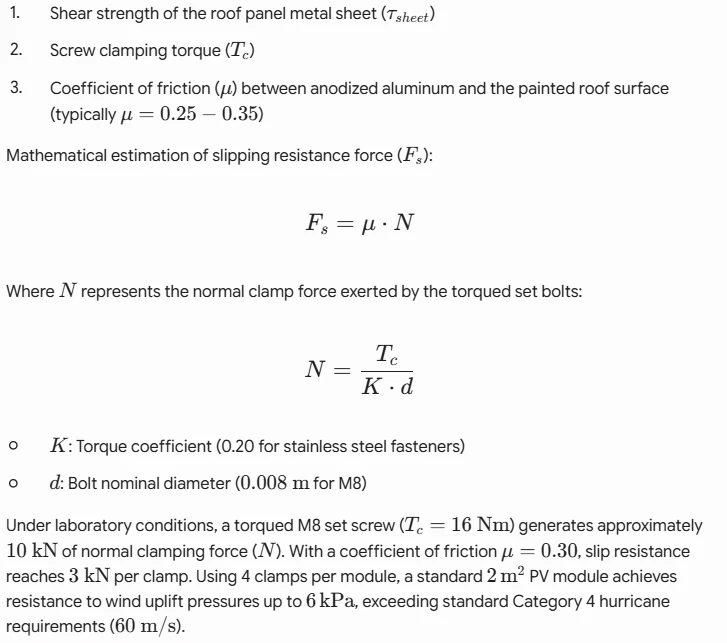
The pull-out capacity ($F_u$) of a non-penetrating clamp depends on three variables:
Frequently Asked Questions
What is the minimum order quantity (MOQ) for custom OEM standing seam clamps?
Our standard factory MOQ is 1,000 units for stock profiles and 5,000 units for custom OEM extruded aluminum profiles tailored to proprietary roof seam geometries.
How do non-penetrating clamps accommodate thermal expansion of metal roof panels?
Non-penetrating clamps grip the raised seam without anchoring down through the sub-structure, allowing the underlying metal sheet to expand and contract linearly along its thermal movement tracks.
What certifications support wind load calculations for utility-grade projects?
Our standing seam solar clamps undergo structural load testing certified under AS/NZS 1170.2, ISO 9001 quality management standards, and SGS mechanical tensile verification reports.